Riding Repair Teams Explained:What Fleet Managers Should Know Before Mobilising a Repair Crew
A main engine defect identified mid-voyage. A cargo pump failure on a laden tanker with a tight discharge window. A crack in a structural frame discovered during inspection at anchorage. In situations like these, the vessel cannot always wait for the next dry docking opportunity, and a diversion to yard is often disproportionate to the scope of work required.
This is where riding repair teams come in. These specialist crews are mobilised to join a vessel at sea, at anchor, or alongside in order to carry out defined repair work without removing the ship from service. For many fleet managers and technical superintendents, however, the concept is still often encountered under pressure, when a decision has to be made quickly and with limited room for error.
In practice, the challenge is not only whether a repair team can be sent. It is whether the repair can be executed safely, efficiently, and without creating further delays through poor preparation, unclear scope, or missing class coordination.
Riding repair teams are most valuable when time matters, but time is also where most mistakes begin. The faster the mobilisation decision, the more important scope clarity becomes.
What Is a Riding Repair Team?
A riding repair team, also referred to as a riding squad or riding crew, is a group of specialist marine technicians deployed to a vessel to carry out repair or maintenance work outside of a scheduled dry dock or port repair period. Instead of the vessel going to a repair facility, the team travels to the vessel and works within the conditions available on board.
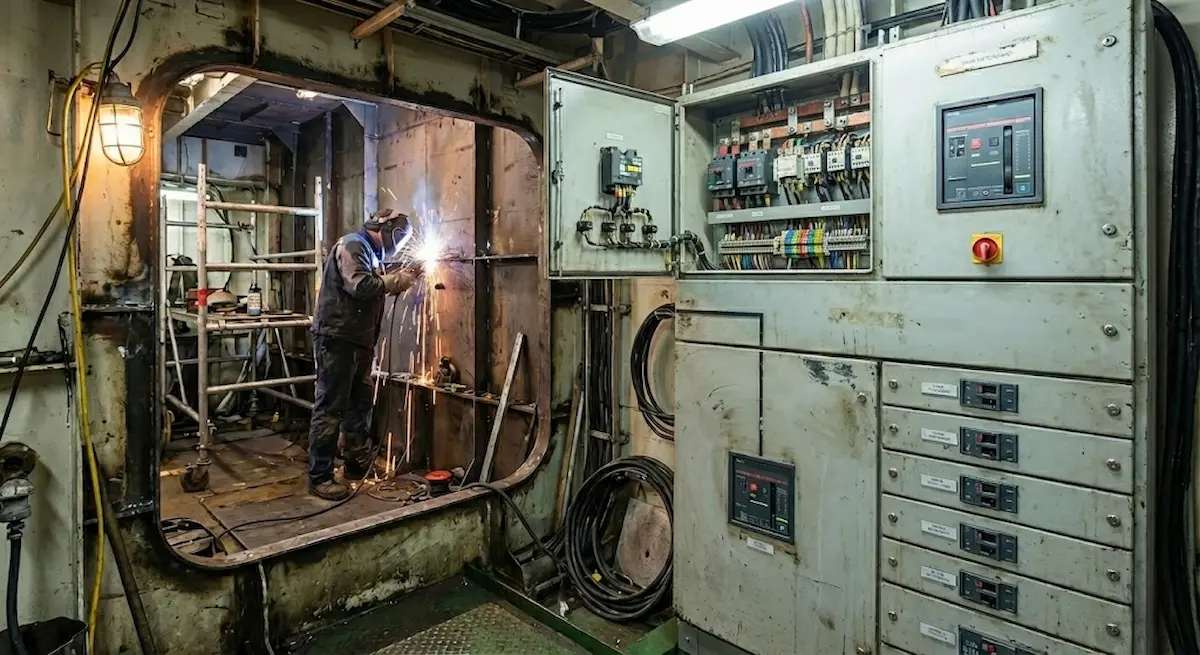
Depending on the project scope, a riding repair team may consist of an individual specialist or a complete multi-trade crew. SSE can provide personnel in the following disciplines:
- Steel workers and hull fitters
- Fitters and deck fitters
- Pipe fitters
- Certified welders
- Electricians
- Foremen and supervisors
Where required, the team can include a foreman or supervisor who coordinates the work onboard, liaises with the vessel’s chief engineer or technical superintendent, and supports the required repair documentation and inspection process.
A riding repair team is deployed for a defined repair or maintenance scope. Depending on the project, it may operate as a complete supervised team or provide additional specialist manpower alongside the vessel’s crew or shipyard workforce.
When Should You Mobilise a Riding Repair Team?
The decision to mobilise a riding squad is usually triggered by one of three scenarios.
1. Unplanned defects requiring immediate attention
Machinery failures, structural defects, or system breakdowns may develop in service and cannot always be managed by the vessel’s own crew until the next planned stop. In these cases, the priority is rapid mobilisation and the ability to join the ship at the next feasible location.
2. Planned work that cannot wait for dry dock
Certain repairs fall due between docking intervals. These may include topside steel renewals, pipe modifications, electrical repairs, or machinery work that exceeds the capacity of the vessel’s crew but does not justify withdrawing the ship from operation.
3. Additional scope identified during port attendance
A superintendent may discover further defects during an attendance, while the available port window or local yard capacity is insufficient to complete everything alongside. In such cases, a riding team can continue the work while the vessel proceeds on schedule.
The common factor in all three is the same: the vessel must continue trading, but the defect cannot simply be postponed or carried as an unmanaged risk.
In many cases, the decision is not whether a repair is needed. It is whether the repair can be completed without disrupting the vessel’s commercial programme. That is where riding teams create the most value.
What Can a Riding Repair Team Actually Do?
The scope achievable by a riding repair team can include accessible steel and hull work, piping, certified welding, and marine electrical and automation work.
- Hull and deck steel repairs on topsides and accessible internal structures
- Insert plating, frame repairs, brackets, and local steel renewals
- Piping installation, renewal, modification, and repairs across vessel systems
- Certified welding of structural steel and pipework
- Electrical fault finding, cable installation and replacement, and switchboard repairs
- Electric motor and generator inspection, repair, and overhaul support
- Electrical and automation installation and modification work
- BWTS installation support, including piping and electrical integration
There are, however, clear limitations. Work involving the underwater hull, propeller, rudder, stern tube, and sea valves generally requires docking or highly controlled specialist diving operations. Likewise, class-required docking surveys cannot usually be replaced by standard afloat attendance.
The limits are not only technical. They are also logistical. Access restrictions, cargo condition, available accommodation, weather exposure, consumable supply, and safe workability at sea all shape what can realistically be delivered on board.
A repair that is straightforward alongside may become far more complex once the vessel is underway. Working conditions should always be reviewed with the contractor before the final scope is confirmed.
How to Prepare a Vessel for a Riding Repair Team
The success of a riding repair mobilisation depends heavily on preparation before the team boards. Poor preparation leads to lost time on board, extended attendance, and avoidable cost.
Define the scope precisely
The contractor should receive detailed defect reports, photographs, measurements, drawings where available, and any relevant class correspondence before mobilisation. Unclear scope leads to unclear quotations and onboard surprises.
Confirm accommodation and working arrangements
Riding teams need cabins, mess access, permits, and coordinated access to work areas. The vessel’s master and chief engineer should be informed early, and onboard arrangements should be confirmed before departure.
Arrange materials and consumables
One of the most common causes of delay is not manpower but materials. Steel, pipe spools, fittings, cables, welding consumables, testing equipment, or special tools must be clearly assigned to either the contractor or the vessel’s logistics chain before mobilisation.
Notify class where required
If the repair affects class-related structure, machinery, pressure systems, or certification status, survey attendance and procedural approval may be needed. This should be addressed before work starts, not after the team is already on board.
Brief the chief engineer properly
The chief engineer is the team’s primary onboard contact. If expectations, access limits, isolation requirements, or operating constraints are not clearly aligned in advance, the first part of the attendance is often spent resolving preventable coordination issues.
In practice, the first lost hours of many riding repairs are caused by access, accommodation, permits, or missing materials, not by the technical work itself.
Mobilisation: What to Expect and How Long It Takes
One of the first questions asked by fleet managers is how quickly a riding repair team can be deployed. The answer depends on three main factors: available workforce, vessel location, and logistics complexity.
For vessels calling at major hubs such as Rotterdam, Singapore, Piraeus, or Fujairah, a capable contractor can often mobilise within 24 to 72 hours once the scope is confirmed and commercial approval is in place. For vessels in remote anchorages or between ports, the actual joining plan depends on travel routing, visa requirements, launch access, and port coordination.
In many cases, mobilisation delays do not come from the contractor’s manpower availability. They come from incomplete information, changing scope, late material decisions, or delayed owner-side approval.
When assessing a contractor, look beyond the day rate
- Team certifications and trade qualifications
- Experience with the vessel type and repair scope involved
- Ability to mobilise across the vessel’s trading area
- Past riding repair references
- Capacity to provide specialist equipment, testing, and documentation
Class Society Coordination for Afloat Repairs
When a riding repair team is carrying out work that falls under classification requirements, class coordination should begin before work starts. This includes structural repairs, class-relevant machinery items, pressure systems, and any work that may affect statutory or class status.
Most class societies allow afloat repairs to be accepted provided the work is carried out to the required standard, by suitably qualified personnel, under the right level of survey control, and with the necessary documentation, traceability, and inspection records.
The key point is timing. The surveyor should be notified as soon as the defect and proposed repair method are known. Waiting until after the work has already started creates unnecessary risk, even when the technical execution itself is sound.
Treat class notification as a parallel process, not a final step. The repair contractor and class surveyor should be engaged at the same time.
What Typically Goes Wrong
The most common problems in riding repair work are rarely about whether the team can perform the technical task. More often, they are about coordination failures around the task.
An unclear defect report leads to an incomplete mobilisation. Missing materials delay execution. Lack of class alignment creates documentation problems later. Accommodation issues reduce productivity from day one. These are not unusual exceptions. They are the typical reasons why a straightforward repair becomes longer, costlier, and harder to close out properly.
A well-prepared riding repair keeps the vessel moving and resolves the defect efficiently. A poorly prepared one simply transfers delay from the port schedule to the onboard execution phase.
Conclusion
A riding repair team is not just a service arrangement. It is a practical operational tool for keeping a vessel trading while essential repair work is carried out.
Used correctly, it helps avoid unnecessary off-hire, limits disruption to the voyage schedule, and resolves defects to the required technical standard. Used poorly, it becomes another source of delay onboard.
The difference is usually not the repair itself. It is the preparation behind it: a clearly defined scope, the right contractor, proper logistics, and early coordination with class.
Riding and Mobile Repair Teams from SSE
Ship System Electric Ltd provides individual specialists, complete repair teams, and additional manpower support for steel and hull repairs, piping, welding, and electrical works during voyage, in port, at shipyards, and in dry dock.
Teams are selected according to the required trades and qualifications and mobilised with valid certificates, safety training, and travel documents, including seaman’s books where required.
This article is intended as a professional reference guide for fleet managers, technical superintendents, and maritime technical staff. Specific repair decisions should always be evaluated in consultation with the relevant class society and a qualified ship repair contractor.