Ship Piping Repair vs. Renewal: When Should a Pipe Section Be Replaced?
The decision between a local pipe repair and section renewal should be based on measured condition, system duty and the applicable acceptance requirements - not on visible corrosion alone. A ship pipe section should be renewed when its remaining wall thickness is below the applicable minimum, deterioration is extensive or recurrent, or a local repair cannot be completed, inspected and tested with reliable results.
Is there a universal corrosion limit?
No. There is no single corrosion percentage that determines repair or renewal for every ship piping system. The acceptable condition depends on the original nominal thickness, the required minimum thickness, pipe material, diameter, design pressure, temperature, service medium and the rules applicable to the vessel.
Visible corrosion shows that inspection is required, but it does not establish the remaining strength of the pipe. The affected area should be cleaned as necessary, measured and assessed against the relevant acceptance criteria. The decision must consider whether the pipe can continue to perform its intended function safely and whether a proposed repair can be executed and verified onboard.
What should be checked before choosing repair or renewal?
The assessment should define both the condition of the damaged area and the surrounding pipework. A small visible defect may extend further than expected, especially near welds, bends, flanges, supports or previously repaired sections.
- Measured remaining wall thickness
- Extent and pattern of corrosion or erosion
- Condition of adjacent pipe, welds and fittings
- Leaks, cracking, deformation or repeated failure
- System pressure, temperature, medium and criticality
- Access for isolation, preparation, welding and testing
Visible corrosion is a reason to inspect and measure. It is not, by itself, the repair decision.
Repair vs. renewal
A local repair may be appropriate when the defect is isolated, sufficient sound material remains and the completed work can be inspected and tested. Section renewal is normally the stronger solution when deterioration extends beyond one clearly defined point or the remaining integrity cannot be demonstrated.
Does a leak automatically require section renewal?
No. A leak confirms that containment has failed, but it does not automatically determine the full repair scope. The system should first be safely isolated and the affected section inspected. The assessment must establish the cause and extent of the defect and whether the adjacent pipe remains suitable.
A technically justified local repair may be possible where damage is limited and sound material remains. Renewal is generally more appropriate when the leak is associated with widespread thinning, cracking, deformation, repeated failure or insufficient remaining thickness.
Approval, inspection and testing
The final repair or renewal scope should follow the vessel owner’s technical requirements and, where applicable, class and flag-state requirements. The proposed method, materials, welding procedure, personnel qualifications and acceptance criteria should be confirmed before work begins.
Inspection and testing depend on the piping system and the agreed scope. They may include visual examination, dimensional checks, weld inspection and pressure or leak testing. The completed work should be recorded so that the owner, superintendent and attending surveyor can verify what was repaired or renewed and how final acceptance was established.
Onboard piping repair and installation
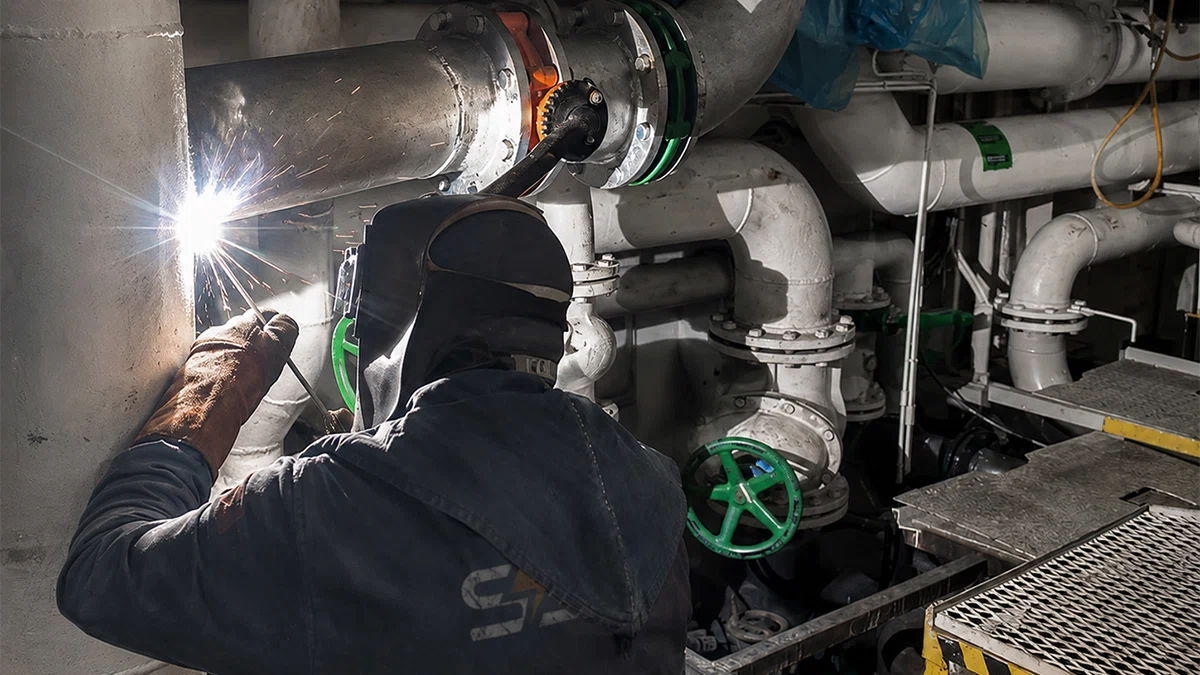
Ship System Electric Ltd’s repair personnel carry out onboard piping repairs, replacement-section preparation, fit-up, welding and installation support during port stays, dry dock periods and voyage repairs.
SSE’s onboard piping scope includes inspection of damaged sections, pipe fitting and welding, final installation, pressure testing and final checks in accordance with the agreed work scope.
- Onboard assessment and measurements
- Pipe-section preparation and prefabrication
- Fit-up, welding and installation
- Inspection and agreed testing
Onboard pipe-section repair carried out by an SSE repair team.
Conclusion
Local repair is appropriate only when the defect is limited, sufficient sound material remains and the work can be reliably inspected and tested. When deterioration is extensive, recurrent or below the applicable minimum thickness, the affected pipe section should be renewed.
Need support with an onboard piping scope?
Contact SSE to discuss your piping repair or section renewal requirements.
CONTACT SSE